Communications In Organizationsistudy


Organizational communication is the process by which groups of people convey company goals and the way to reach them. Organizational communication is an integral part of effective management practices within the workplace: productive and thoughtful dialogue can make or break an organization and the relationships within it.
- Types of Organizational CommunicationPart 1
- Communication’s Link to CollaborationPart 2
- Organizational Communication ImpactPart 3
- Challenges to Organizational CommunicationPart 4
- Best PracticesPart 5
Macalester College 1600 Grand Avenue Saint Paul, MN USA 651-696-6000.
Part 1
Communication no doubt is a very vital tool in carrying out our day to day activities. Every one needs communication with people around to share experience, jobs, frustration, hopes and fears from childhood. We all learn how to communicate as children, we are able to recognize and identify happiness and annoyance in our parents faces or words. Warren Buffett once told a class of business students that he would pay $100,000 for 10 percent of their future earnings — and increase his bid by 50 percent if they also possessed effective communication skills. Pairing valuable communication expertise with a versatile business foundation, the W. Carey business degree in communication prepares you for a bright future in your industry.
Types of Organizational Communication
To understand the far-reaching impact organizational communication has on companies, it is important to understand the various types that take place within companies:
- Organizational Communication Certificate 12 credits This certificate complements majors in every area of study by developing professional, group and interpersonal communication skills that enable students to contribute to, and better serve, the communities, organizations and societies in which they live and work.
- For organizations to be successful, they must have competent communicators. Organizational communication study shows that organizations rely on effective communication and efficient communication skills from their members.

Informal and Formal Communication
Another word for these two are official and grapevine communications respectively.
Formal communications are pre-defined channels that employees or leaders can use to reach out to others.Informal communications do not rely on already established channels; as a result, contacts can spread to any number of channels.Vertical and Horizontal Communication
The defining characteristic of these communications is hierarchal.
Vertical communication happens between superiors and subordinates while horizontal communication between individuals on the same employee level.Vertical discussions are further split into upward and downward depending on where the dialogue is coming from.
Both groups of communications address more specific interactions between employees, managers, and upper management. Even a basic understanding of these is critical for anyone looking to increase the communication flow in the organization.
Part 2
Communication’s Link to Collaboration
If organizations represent buildings, departments are the building blocks and communication is the substance that binds them together. Marketing, human resources, finance, accounting, operations, and management all have to collaborate with one another to reach departmental and company goals. Effective communication positively contributes to organizational collaboration that needs to occur.
Valuable collaboration is synonymous with efficient communication. However, the structure of today’s workplace, a penchant for silos, and generational gaps have contributed to a landscape that is not always conducive to satisfactory communication practices. Here are some statistics that reveal the state of today’s workplace collaboration culture:
- 44 percent of top executives feel that soft skills (like communication) are the most considerable part of the U.S. skill gap.
- 80 percent of millennials would prefer real-time feedback over traditional performance reviews.
- Three out of four workers rated teamwork and collaboration as “very important.”
- Only 18 percent receive communication evaluations as part of their performance reviews.
- 27 percent of workers receive communication training. This group also felt more confident in their workplace communication abilities.
- 39 percent of those surveyed think that people in their organization do not collaborate enough.
These statistics from this survey conducted by the Queens University of Charlotte show the complicated relationship between communication and collaboration. Executives and business leaders desire employees to have communication skills already, but once they arrive at the organization, there are not a lot of opportunities for them to further the develop the skills they do have or learn new ones. This has a negative impact on how communication flows throughout an organization.
Part 3
How Does Organizational Communication Impact Productivity?
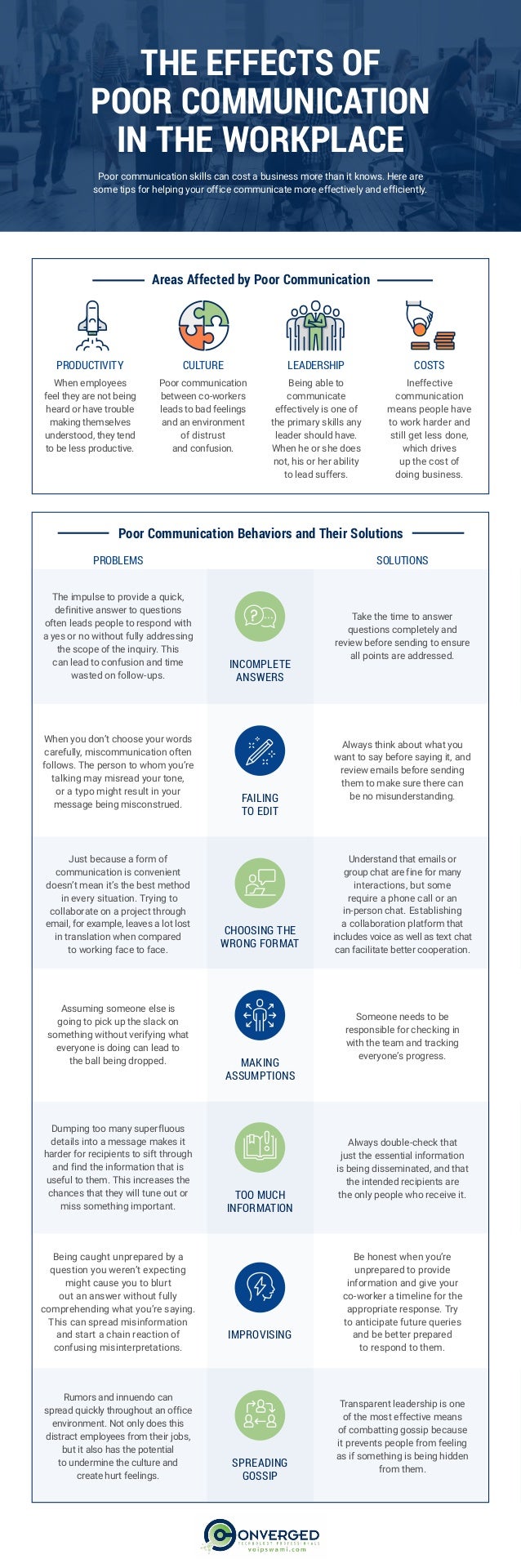
So much can become lost in translation. Different personalities create diversity in learning and listening styles.
People communicate the way they were taught, and as individuals grow into adulthood the way people explain themselves and the way they listen to others becomes even more solidified. This makes it difficult for people to take on new communication skills, but statistics show that being flexible and open to new ways of communicating are essential.
According to a survey of 4,000 employees by HR Magazine, almost half were unsure of what was being asked of them by managers who gave them a task to do.
What was even more troubling is that 36 percent felt this uncertainty between one and three times in the workday. This reveals that managers think they are saying one thing while workers feel they mean something entirely different. This can have detrimental effects on company productivity. An employee can get halfway through a project and find out they misheard the directions. This impacts time and money spent for the worker to finish the project. Communication contributes to the overall bottom line, so leaders should recognize its connection to productivity, and create strategies to improve lapses in communication.
Part 4
Challenges to Organizational Communication
The key to creating an environment of effective communication is building a comprehensive organizational communication plan. Business leaders and employees who participate in creating this plan need to prepare for communication challenges that come into play in modern workplaces.
Taking Size into Account
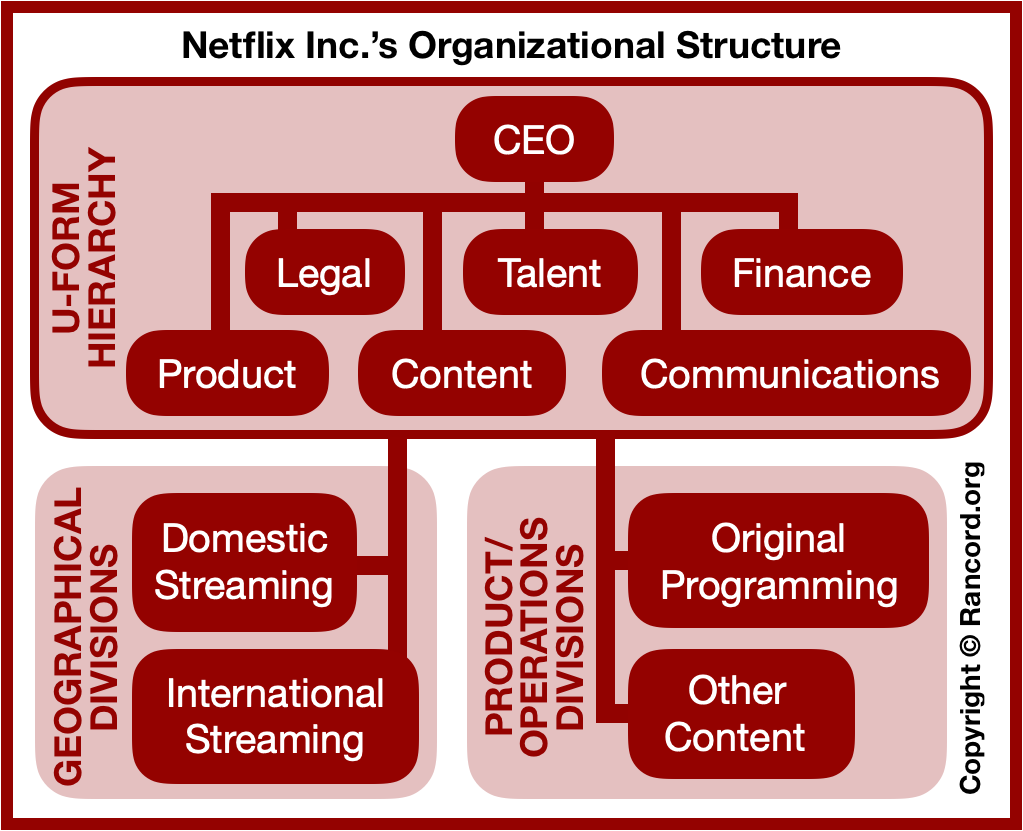
The size of an organization can create a barrier to communicating effectively. If there are hundreds of employees with multiple departments and sub-departments under those, getting out various formal messaging from upper management to every employee level can be daunting.
Check howProsperForms solution helps solve the problem of interdepartmental communication.How Can You Ensure Accountability?
Managers and leaders can mix up messaging all of the time, but how can anyone keep track of where the lapse in communication happened? If there is not a culture in place that acknowledges that mistakes are inevitable and uses them as situations for people to learn from, then accountability will be difficult to implement.
Creating A Plan That Is Relevant to Everyone
Different roles and functions within a department require various solutions to communication problems that may arise.
How can a plan be relevant to units who have virtual teams, managers who favor weekly meetings, and teams who are on autopilot and do not see the need to meet frequently?
Is there a uniform approach that everyone should adhere to or is there no one right way for everyone? If policies are changed to favor one style over another, what is the backlash? Should that even be the right approach in the first place?
Part 5
Organizational Communication Plan Best Practices
There are many ways leaders can address the challenges faced when creating a comprehensive communication plan that enhances the flow:
Assess the Current State of Organizational Communications
• Are employees regularly missing deadlines?
• Are teams unaware of the quarterly goals they have to meet?
• How are virtual teams involved in modern communications?
These questions are ones business leaders have to consider when they create an organizational plan.Identify problems to develop applicable solutions within the organizational communication plan.Think About Incorporating Digital Tools
Technology is not a cure-all for everything, but there are times where software can be a fix for organizational communication. When 1,000 millennials were surveyed by Microsoft about the type of workplace they prefer, 93 percent said the latest technology was a major factor in their decision to work for a particular employer. For the largest generation in the United States, smart uses of technology matter.
Modern communication software like ProsperForms and free collaborative software like Fluxes can keep teams in touch with each other in real-time at their work and personal computers; while Google Docs can allow teams to work on documents simultaneously.Find Ways to Appeal to a Variety of Communication Styles
Everyone digests information differently, so managers should try to incorporate face-to-face meetings, online updates and private feedback, data visualization for goals and benchmarks, and motivational quotes to get team members inspired. Communication should not have a one size fits all approach. The plan should include communication options and ideas for various types of workers. People should be given as many options as possible.
Remind Employees Why They Come in Every Morning
Employees do not have to be beaten over the head with the organization’s cause, but it is crucial to remind the team of the organization’s mission and vision for the future. These will likely align with the goals of the company so posting these messages around the office or mentioning them during meetings brings unity to the team. When everyone feels they are on the same page it is easier for the team to rally around communication efforts.
Get Rid of Unnecessary Silos
It is disheartening when two or more departments in a mid to large-size organization are doing similar work or are completing projects that complement one another, and they are not aware of their synergies because they do not communicate. A communication plan should facilitate department Q&A sessions or “Lunch and Learns,” for employees and managers to come together and discuss what they are working on. Alternatively, a few simple interdepartmental feeds with regular updates on ProsperForms can allow business leaders and managers significantly improve communication between departments.
Read next:
ProsperForms is a cloud solution for effective organizational communication. It brings a more light-hearted tone to messaging making it easily digestible, and makes it easy for team members to provide and receive updates regularly.
How to use ProsperForms for effective workplace communication:
- Upward communication:
a) Easily implement daily or weekly status updates for your team members by creating a status feed “How did you contribute to the team’s goals this week?”.
b) Create automated scheduled questionnaires with questions like “How can we improve?”, “Do you have any obstacles?”, etc. - Downward communication:
a) Build trust and improve leadership communication by sharing regular updates and reasoning behind your decisions.
b) Share information about company announcements, branch news, new hires, etc.
c) Share company goals and objectives regularly. - For recurrent questionnaires: no one forgets to post an update because it sends automated reminders according to the recurrence schedule you chose.
- Increase workplace satisfaction by improving transparency:
Each status update has a separate section for comments, which is used by team members to clarify information, including upcoming goals, and by leaders to provide feedback and coordinate better without micromanagement, post congratulations and acknowledge job well done. - Use status updates for future reference and decrease time and efforts spent on monthly, quarterly, and yearly reporting thanks to powerful filtering and export features.
- Optionally, enrich reports with the latest updates automatically added from web apps your team uses (such as project management tools, version control systems, support systems, financial applications, CRM, etc.) by connecting these apps to your status feed.
- Spend less time on meetings by making them more productive because everyone is on the same page at all times.
- Sharing: Status updates can be either
— exported to files and printed, or sent by email;
— shared with manager online; or
— shared online as company-wide or team-wide status reports, i.e., all team members share their progress with each other.
Communications In Organizations Study Examples
How to configure status updates:
Step 1: Create your account and create a new applet by selecting a customizable form template.
- Configure who will add records by choosing the “Participants” tab.
- Set the applet as “Team-wide” if you want all team members to view each other’s records.
- Alternatively, you can allow each participant to view his/her own records only and stakeholders to view all entries.
- Step 2: Users will click the “Open Submission Form” button to fill it out and submit it.
As soon as a new record is added, participants with “View” rights will receive an email notification and can view it in real time on the Timeline screen.
- Employees can discuss records in real time — each record has its own section for live comments.
- Add an unlimited number of attachments (documents, images, photos, videos, audio notes, files) to a record.
- Export records or share them online.
Get instant access to historical data and files with powerful search and filtering capabilities:
The dashboard screen allows you to save time when you want to check a high-level overview, with quick one-click retrieval of the relevant information.
The communication blitz is a proven approach to communicating key messages effectively throughout an organization. Individuals looking to improve communication within their organization and enhance employee engagement can adopt the easy-to-use process introduced in this article.
During a large project, when many things are changing, there is an increased need for ongoing communication to all employees. When implementing a continuous-improvement initiative, effectively communicating the changes is essential to success. Change management during a big project is just that — managing the change itself. The communication blitz provides proactive messages to help manage the change within an organization.
A large project like an implementation of reliability excellence requires a master plan that includes major tasks and milestones, and a well-designed change-management plan. The change-management plan needs to include a comprehensive communication plan. The communication blitz, a subset of the communication plan, is a series of communications delivered face to face from the leaders who sponsor the change all the way to the hourly employees working at the site.
Prepare to Follow the Sequence
The approach is simple. First, senior leaders develop a succinct, short message. They then divide up the front-line supervisors into equal groups. The leaders go out into the work areas of the supervisors, discuss this message, seek open discussion and check for retention with the supervisors. This can be done individually or in small groups.
Next, the supervisors meet with their employees in small groups and deliver the same message. After a short period of time, usually around two to four weeks, the leadership group interviews a sample of the hourly employees to determine if they can explain the message. They develop questions specific to the message delivered so that there is a standard approach to talking with the hourly employees. The goal is to have 40 percent retention, meaning that 40 percent of the employees can clearly articulate the message. After attaining 40 percent or better, the next message can be developed, and the cycle begins again. See Illustration 1.
Illustration 1
Forty percent is the minimum number of people who should have a strong understanding of the messages to make sure the communications are getting through. This dramatically improves the likelihood of the changes taking hold. When scoring the retention, it is a good idea to develop a matrix of the key questions and the list of employees who received the message. See Illustration 2.
Illustration 2
It is important to document how well the employees have retained the message. Talking to a few people to get a gut check is too subjective to make sure the message was well received. Using this simple matrix helps to make sure that the desired outcome has in fact occurred. When actually scoring the retention, three levels of response should be expected – full recall, some recall or no recall. Two people are usually involved in conducting the review — the top site manager and the project leader. This typically requires two 2-hour sessions, carrying a clipboard with the questions and any additional information that you would like to leave with each person interviewed.
From this example, we can analyze how well the message has been retained and communicated back during the evaluation. Reviewing this scorecard example (the totals per person down the right side and then totals per question across the bottom) reveals the strengths and weaknesses of the results. Reviewing the scores of the people indicates the “operator” has low understanding. Further review with other operators should be conducted to determine if it was a single person that missed the content or if all operators were missing the main points. The totals across the bottom illustrate that discussing “How long will this change take?” had the lowest score. It was not clearly communicated and needs to be repeated.
Every round of the blitz has to have a judgment call regarding the need for a partial or whole message to be repeated. In this case, repeating the details around “How long will this change take?” is necessary, but the rest of the message in round two can be new content.
Additional Considerations
It is important to avoid a common mistake with organizational communications — measuring the success of a communication from the sender’s point of view. Leaders frequently feel that “we told them” or “we have communicated this with a town-hall meeting, sent e-mails and put out posters regarding this message, they must know what we’re talking about.” In fact, they are assuming the employees got the message because of their high confidence in the development of the message and channels selected to deliver it. There are always opportunities to improve the effective delivery of a message, yet the only way to avoid assumptions of retention is to monitor retention with the receiver. See Illustration 3.
Illustration 3
The effectiveness of a communication should always be monitored by conducting face-to-face evaluations with the hourly employees, seeking to understand how much can be recalled. This has multiple positive effects. Site leaders are seen out in the work areas, leaders are following up on the message illustrating the importance, employees feel valued when they are asked these questions by top leadership, supervisors feel valued by having direct face-to-face time with the top leaders and the top leaders end up learning things about the employees and supervisors from their time together.
The cost to perform a communication blitz is the leadership’s time. It is much more efficient to send an e-mail and expect the employees to get the message. The most efficient approach is also typically the least effective. The investment in time is well worth the return. How many times has a big change been rolled out with minimal training and poor communication? When only the efficient methods are used, the results are usually meager at best.
Another important concept is that the communication blitz is intended to be a series of messages, not just one round. When the leaders are out checking the retention of the second and third messages, different employees should be approached. For each round that this is performed, a new message and subsequent questions need to be developed.
Including the top site leader during retention checks sends a significant message about the importance of the project at hand. When the hourly employees are approached by the top manager and the project manager, they get a clear message about the importance of the change and how they need to make sure to engage any information coming out about this project going forward.
Patricia Landry was leading the manufacturing excellence implementation at the Noranda Alumina processing plant in Gramercy, La., over the last couple years. Here’s how she reflects on her experience using the communication blitz approach.
How important is it to focus on clear, concise communications during a big project?
It is the No. 1 aspect that a management team must do to implement a change. Depending on the change, once employees understand the nature and the reasons behind the change, they typically will be more accepting of the project/change.
How would you rank the ability of the leadership team to communicate with employees before this approach was used?
The management team here at Noranda Alumina would be the first to admit that communication is not our strong suit. The communication blitz offered us an organized way of communicating to our 400(+) employees.
What was it like developing the first communication blitz?
Developing our first blitz taught us to focus on our audience. We understood the specifics of the project and did not need to communicate that in detail. We needed to let them know the basics and how it was going to affect them. We learned to keep it simple.
How long did it take to roll out the message to all employees?
The blitz was designed to take a month to communicate to everyone that we needed to reach. It actually took us a couple of weeks longer.
How did you get the leadership team to divide up and go out to speak with the supervisors?
We split the plant into segments, and each person volunteered for the areas that they wanted to be responsible for.
Did supervisors embrace or resist the communication effort?
They embraced it.
Did hourly employees embrace or resist the communication effort?
I wouldn’t describe their reaction as embrace or resist but more of a “wait and see” attitude. It sounds good, but they are skeptical.
What kind of feedback did you get during the message-evaluation step?
It was positive. Most people had to be prompted. Once they were reminded of what manufacturing excellence was, they remembered the communication.
What did you learn from the whole process of developing, rolling out and auditing the effectiveness of the first communication blitz?
We learned that we have to remember our audience. The follow-up is also very important. What employees understand and what you intend to communicate can be two different things.
Do you foresee this blitz approach playing a role in your communications going forward?
Yes, the manufacturing excellence steering team intends to continue communicating using the blitz method. It was even suggested as a communication tool corporate-wide at a leadership conference in September last year.
Improving communications within an organization is not as difficult as many leaders may believe. Adopting the communication blitz process can bolster your change management strategies and improve both employee engagement and the sustainability of the changes at hand.
About the Authors
Communications In Organizations Study Standards
Patricia Landry is a maintenance manager of the Noranda Alumina processing plant in Gramercy, La. As project manager over the manufacturing excellence project, she was responsible for implementing more than 25 major process changes this year to drive up the reliability and reduce production losses without changing the asset or employee base. She was also accountable for all change-management efforts, including project communications with 400+ employees.
Joe Mikes is a senior consultant with Life Cycle Engineering. He was working directly with Patricia throughout the project. He has also helped numerous other companies launch and sustain continuous improvement initiatives. He can be reached at jmikes@LCE.com.
 About the Author
Communications In Organizations Study Articles
Joe Mikes, CMRP, is a senior consultant at Life Cycle Engineering. Joe has helped dozens of organizations improve their performance while producing their goods safely. You can contact Joe at Read More
About the Author
Patricia Landry is a maintenance manager of the Noranda Alumina processing plant in Gramercy, La. As project manager over the manufacturing excellence project, she was responsible for implementi...Read More